

Most organizations arrive at brand monitoring the same way. Something gets published, nobody sees it for days or weeks, then someone asks why.
The obvious next step is to buy a platform, but that's usually where it stalls. Enterprise monitoring tools are powerful and genuinely good at what they do, but they arrive as empty dashboards. Someone has to configure the searches, write the query logic, decide who gets alerted about what, and then maintain all of it as the business changes.
There's a second option that gets discussed less: keep the monitoring technology and hand off the work of running it.
We’ll cover handing off management and monitoring to an expert, what the tradeoffs are, and how to tell which approach fits your organization. If you're earlier than that and still working out what brand monitoring covers, start with our guide to brand monitoring.
Brand Monitoring Software vs. a Managed Service
Most comparisons in this category are software versus software. But the decision most communications teams are actually making is whether monitoring is something your team runs or something your team receives.
What running it yourself involves
A platform subscription gets you access to the technology, but everything that makes it useful is separate work:
- Custom keyword setup: deciding what to track, including brand variants, misspellings, executive names, products, campaigns, and industry terms
- Boolean query development: writing the search logic that separates relevant mentions from everything that happens to share a word with your brand name
- Alert configuration: setting thresholds, frequency, and formats so notifications are useful rather than constant
- Recipient management: determining who receives what, and updating it as roles change
- Ongoing query maintenance: refining searches as products launch, executives change, and new terms enter your category
- Platform administration: an internal owner who knows the tool and stays current on it
- Onboarding and training: for anyone that is using the platform
All of these elements are the difference between a monitoring program and a monitoring subscription, and it typically lands on a communications team that already has a full workload.
What a managed service handles
The managed model keeps the same underlying technology and moves that work off your team. In LT's case, that means being powered by Meltwater's monitoring platform, configured and maintained by our team:
- Custom keyword setup built around your organization's actual priorities
- Boolean query development, professionally written and tested
- Alert configuration and recipient management, adjusted as your team changes
- Ongoing query maintenance and optimization
- No platform training required as nobody on your team needs to learn a new tool
- No platform administration as there is no internal owner, no seat management, no onboarding cycle
You receive the alerts and we handle everything that makes them accurate.
Which one fits?
Neither model is universally better, and they fit different organizations.
A platform subscription makes sense when you have a dedicated communications or PR operations person with capacity to own it, you want direct access to historical data and ad-hoc analysis, or you're running enough monitoring across enough brands that in-house expertise pays for itself.
A managed service makes sense when monitoring is important but nobody's workload has room for it, you need it working in weeks rather than after an onboarding cycle, your team turns over enough that platform knowledge keeps walking out the door, or you'd rather spend your time acting on mentions than configuring searches to find them.
A platform subscription is one line item plus internal labor that rarely gets counted. A managed service bundles both. Which is cheaper depends entirely on what that internal time is worth and whether that time exists in the first place.
Looking for a Google Alerts Alternative?
Plenty of organizations start with Google Alerts, and it's a reasonable place to start. The move away from it usually happens for one of two reasons: 1. something important got missed, or 2. the volume of irrelevant alerts made the relevant ones invisible.
Here's the difference:
|
Google Alerts |
Managed brand monitoring |
|
|
Search logic |
Basic keyword alerts |
Professionally developed Boolean monitoring |
|
Coverage |
Limited web coverage |
News, broadcast, online, blogs, forums, and social |
|
Alert content |
Link only |
Reach, sentiment, source details, and direct link |
|
Management |
Self-managed |
Fully managed |
|
Refinement |
Limited |
Ongoing optimization and keyword maintenance |
|
Oversight |
None |
Alerts configured around your organization's priorities |
The gap that matters most is that Google Alerts gives you a link and leaves the evaluation to you. When you're triaging fifteen mentions before a morning meeting, that's the difference between a workable process and an unworkable one.
What Every Alert Should Tell You
An alert that says "you were mentioned" creates work, but an alert with context lets someone make a decision in a few seconds.
Every notification in LT's monitoring service includes:
- A direct link to the article or social post
- Estimated reach to understand potential visibility
- Sentiment analysis to quickly gauge tone
- Source information so you know where the conversation is happening
- Keyword match showing exactly what triggered the alert
- Publication date and time for immediate awareness
- Real-time delivery to your designated recipients
A negative mention in a low-reach personal blog and a negative mention in a national trade publication require different responses, and you should be able to tell them apart without opening anything. Reach plus sentiment plus source, visible in the notification itself, is what makes that possible.
What Gets Monitored
Monitoring is customized and configured around your organization rather than pulled from a template.
Keywords we track
- Brand and organization names
- Executive leadership
- Products and services
- Marketing campaigns and initiatives
- Community programs
- Industry topics and emerging trends
- Geographic markets
- Competitors, optionally
Channels we cover
- Earned media: national news, local news, trade publications, online news, broadcast television and radio, blogs, forums, and Reddit
- Owned social channels: activity on your Facebook, Instagram, LinkedIn, and TikTok properties
- Public social conversations: mentions and discussion on X and YouTube
Together these give a fuller picture than any single-channel tool: what's being said, where it's gaining traction, and what needs attention now rather than next week.
What Monitoring Catches in Practice
Three patterns come up repeatedly in what monitoring surfaces and all three are places where lighter-weight tools tend to miss.
Niche and gated content: Trade publications and industry outlets frequently carry the coverage that matters most to a specialized organization, and they're exactly what general-purpose tools index poorly or not at all. A mention in a subscriber-only industry publication can shape peer and stakeholder perception significantly while never appearing in a free alert.
International visibility: Coverage doesn't respect geography. Organizations regularly turn up in foreign press like regional papers, international trade outlets, non-domestic aggregators, often with framing or accuracy issues worth knowing about.
Non-brand keyword tracking: Some of the most useful mentions never name you. Tracking an industry topic, a regulatory term, or a category conversation surfaces discussions where your organization has standing to contribute: a reporter seeking a source, a debate where your expertise is relevant, a competitor's claim worth responding to. Brand-name monitoring alone won't find any of it.
.jpeg?width=1932&height=1087&name=download%20(1).jpeg)
Why Search Logic Needs Maintenance
This is the part most easily underestimated when evaluating a platform subscription: monitoring queries decay.
A search built well in January can drift by June. Products launch and need adding, an executive leaves and their replacement doesn't get tracked, a new competitor enters the category, a term that returned clean results starts pulling in noise because something unrelated made it popular, or a brand name that was once distinctive became ambiguous.
Left alone, this fails in one of two directions:
- Either the queries get noisier until people stop reading the alerts
- They get narrower until important mentions stop arriving
Both look like the monitoring is working right up until something gets missed.
Ongoing optimization is the part of the equation that keeps the setup true and accurate.
How LT's Service Works
Our structure:
- Meltwater's monitoring technology provides the coverage for earned media, broadcast, online, forums, and social
- LT builds the program including keyword strategy, Boolean query development, alert configuration, and recipient setup
- LT maintains it by continually refining results to reduce noise and surface what matters
- Your team receives alerts in real time, with the context needed to act
What you don't do: learn a platform, administer seats, write query logic, or need to maintain any of it.
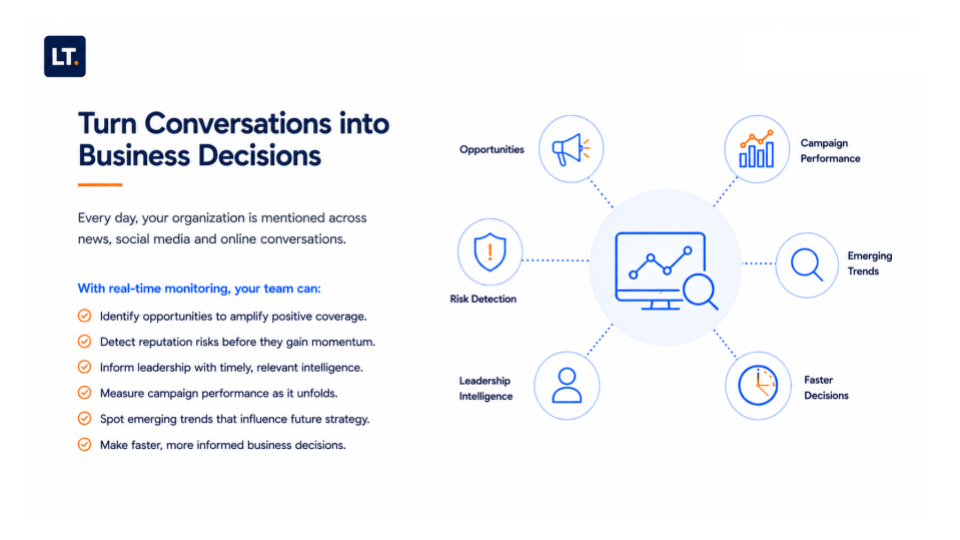
What that produces over time is a clearer read on how your reputation is actually evolving, which conversations are gaining traction, where your organization has an opening, what competitors are doing, and what's worth responding to before it grows.
Where To Goes From Here
Monitoring is usually the entry point rather than the destination, and once an organization can see the conversation clearly, the next questions tend to be about what to do with it.
That's where LT's broader strategic communications work connects:
- Robust reporting and strategic analysis: turning mention data into something leadership can act on
- AI visibility: tracking and shaping what AI platforms say about your brand
- Executive communications: for the leaders whose visibility drives brand perception
- Media relations: to earn the coverage rather than only monitor it
- Crisis response: for when monitoring surfaces something that needs immediate handling
Ready to see what people are saying about your organization? Let's talk.


.jpeg)
-1.png)